
Morning Note: A Round-up of Global Financial Market News.
Market News
Gold drifted back to $4,635 an ounce. This follows a recent bounce as the US Treasury Department announced an expansion of its buyback programme for long-dated government debt in an effort to contain rising borrowing costs, with Secretary Scott Bessent saying he is prepared to increase the buybacks further while also flagging an upcoming longer-term fiscal plan. However, markets speculated that the measures may offer only a temporary solution, while renewing concerns over the risks of a US debt crisis, persistent inflation, and dollar weakness. Gold-backed exchange-traded funds have recorded increased inflows in recent weeks, signalling broader market participation and strengthening investment demand.
Brent crude fell to $91.50 a barrel, extending losses from the previous session as the US intensified economic pressure on Iran and its trading partners. Treasury Secretary Scott Bessent plans to isolate Iran through sanctions targeting countries that continue doing business with the Islamic Republic, while President Trump said those nations would be given a specific timeline to sever ties with Tehran or face unilateral US penalties. The campaign risks a clash with China, which buys around 90% of Iran’s oil.
US equities drifted lower last night – S&P 500 (-0.3%); Nasdaq (-0.8%). However, stock-index futures gained overnight as pressure on technology shares eased, signalling tentative optimism ahead of key earnings that will test confidence in the AI trade. The positive momentum continued in Asia this morning: Nikkei 225 (+0.5%); Shanghai Composite (+0.2%); Kospi (+0.7%). The FTSE 100 is currently 0.2% higher at 10,864, while Sterling trades at $1.3625 and €1.1690.
Traders are looking for Federal Reserve Chairman Kevin Warsh’s Jackson Hole speech later this week to clarify his reaction function to above-target inflation. In other words, what combination of inflation, labour, and financial conditions would cause him to recommend a change to policy.
With the 10-year US Treasury yield above 4.7%, investors can now earn more income from government debt than from almost every stock in the S&P 500. Just 20 of the index’s members, roughly 4%, offer a dividend yield above the Treasury rate – one of the lowest readings since at least 1996.
Canada will announce measures today to ‘protect and support’ workers and businesses in response to 50% US tariffs. The trade talks collapsed after Howard Lutnick intervened, people familiar said.
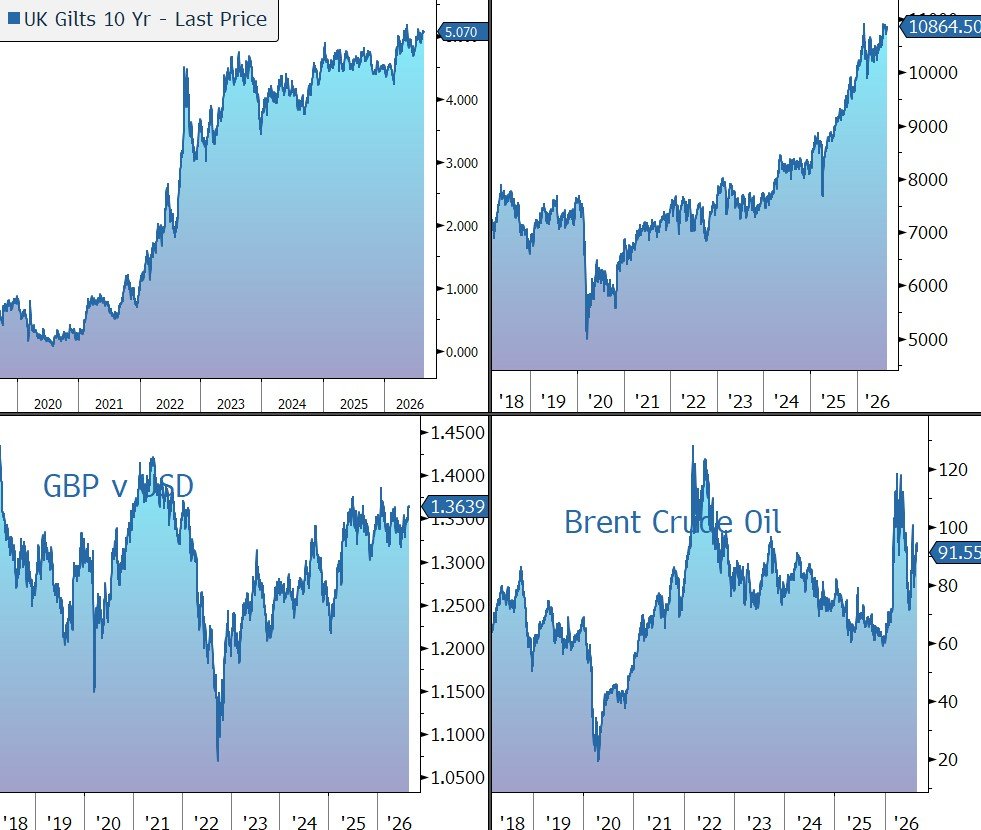
Source: Bloomberg
